Monthly Archives: September 2012

Rising Hip-Hop Star Lineo Ignites Ghana Music Industry Nite

Rising hip-hop star, Adegboyega Yusuf Adekoya, better known as Lineo, excites the fans with his newly introduced style of music, Afro Hip House, at the first Ghana Music Industry Nite held at Accra, Ghana, recently. Lineo  was at his best with brilliant performances alongside Hypertek Music and 2Face Idibia’s protege, Dammy Krane. At the industry nite was also R2Bees, Chidinma and others to mention but few.

“Funky High is a song that is dear to me. It is a complete deviation from the regular Nigerian contemporary hip hop. The song is a blend of Afro beats, Funk, Hip and House Music,” said Lineo. The Elepepe Master ignites the fans with his newly introduced style of music, AFRO HIP HOUSE. However, the Ogun State born singer, “LINEO” experiment with his new single FUNKY HIGH. ‘ The experiment has been awesome.

A lot of music buffs love it that is why we released it.  The song is a blend of Afro beats, Funk, Hip and House Music’, he said “Funky High is a song that is dear to me. It is a complete deviation from the regular Nigerian contemporary hip hop. It is new, it is fresh and above all, it is fun! It’s a song my team strongly believe would open a new chapter in Nigerian music.

The Afro Hip House chapter!”

It may interest you to know Lineo is one Nigerian artiste that understands the essence of the social media in music promotion on Facebook, Twitter, Myspace, YouTube, Google. Having his own online-based Tv channel with over 200,000 views. In fact,the single, Funky High is already on Spinlet, a mobile application platform to distribute music.

The Icon award winner, Lineo is being Signed to Dengit Music Group under Dengit House Productions.

Kindly Download  #FunkyHigh can be downloaded by clicking on the link: http://bit.ly/KGXhoD . Also Available on www.spinlet.com # DengitHouse. You can follow @MyLineo on Twitter. Email : Dengithouse@gmail.com.

King Jaja of Opobo – England’s Affair With Him And The End Of It


Born in Umuduruoha, Amaigbo in Igboland and sold as a slave to a Bonny trader at the age of twelve, he was named Jubo Jubogha by his first master. He was later sold to Chief Alali, the head of the Opubo Annie Pepple Royal House. Called Jaja by the British, this gifted and enterprising individual eventually became one of the most powerful men in the eastern Niger Delta.

In the nineteenth century—after the abolition of the slave trade in 1807—the trade in slaves was supplanted by the trade in palm oil, which was so vibrant that the region was named the Oil Rivers area.

The Houses in Bonny and other city-states controlled both the internal and external palm oil trade because the producers in the hinterland were forbidden to trade directly with the Europeans on the coast; the Europeans never left the coast for fear of malaria.

Astute in business and politics, Jaja became the head of the Anna Pepple House, extending its activities and influence by absorbing other houses, increasing operations in the hinterland and augmenting the number of European contacts. A power struggle ensued among rival factions in the houses at Bonny leading to the breakaway of the faction led by Jaja. He established a new settlement, which he named Opobo. He became King Jaja of Opobo and declared himself independent of Bonny.

Strategically located between Bonny and the production areas of the hinterland, King Jaja controlled trade and politics in the delta. In so doing, he curtailed trade at Bonny and fourteen of the eighteen Bonny houses moved to Opobo.

In a few years, he had become so wealthy that he was shipping palm oil directly to Liverpool. The British consul could not tolerate this situation. Jaja was offered a treaty of “protection”, in return for which the chiefs usually surrendered their sovereignty. After Jaja’s initial opposition, he was reassured, in vague terms, that neither his authority nor the sovereignty of Opobo would be threatened.

Jaja continued to regulate trade and levy duties on British traders, to the point where he ordered a cessation of trade on the river until one British firm agreed to pay duties. Jaja refused to comply with the consul’s order to terminate these activities, despite British threats to bombard Opobo. Unknown to Jaja, the Scramble for Africa had taken place and Opobo was part of the territories allocated to Great Britain. This was the era of gunboat diplomacy, where Great Britain used her naval power to negotiate conditions favorable to the British.

Lured into a meeting with the British consul aboard a warship, Jaja was arrested and sent to Accra, where he was summarily tried and found guilty of “treaty breaking” and “blocking the highways of trade”.

Jaja was forced into exile at St. Vincent, as a political prisoner, and placed on annual income of 800 pounds which was far below estimated at 50,000 pounds income per annum in Opobo, and where he enjoyed a lavish life style, in his three storey pre-fabricated house imported from Liverpool. He was to remain is St. Vincent, against his will, for three years, and for four additional month in Barbados, from where it was decided he should return home to Opobo from exile.

Meanwhile, Jaja’s health in exile began to deteriorate to the extent that his doctor in St. Vincent reported in 1899 that, the more Jaja was retained in St. Vincent the nearer he would approach his grave. Jaja report was threatening to commit suicide unless he was allowed to return.

It took another two years for Jaja to be evacuated from St. Vincent , from where in February, 1891, he was transferred to Barbados. He was to remain in Barbados for another three months before he was conveyed to Spanish colony of Teneriffe, instead of Sierra Lone, on May 11, 1891. The plan was for him to remain there until the arrival of the British consul, Macdonald who was to take him back to Opobo, but, due to an outbreak of epidemic in the island, Macdonald did not arrive in June as expected.

Consequently Jaja waited hopelessly and in abject misery, soon contracted dysentery from which he died on July 7, 1891, after nearly four years in exile. His body was buried at Teneriffe. But in October, 1892, his body was exhumed and taken to Opobo where on October 12, it was received by a fleet at 60 war canoes each carrying each of the old warriors of King Jaja.

Years after his exile in St. Vincent Jaja, is still remembered in anecdotes, today in the West Indies, as he stays there made the land favourable impact on the people of St. Vincent and Barbados. To them Jaja remained a legendary figure. He is remembered for upholding the diginity and self respect of the African even in the most difficult conditions in which he found himself while on exile in Caribbean.

Based on the illegal exile of King Jaja of Opobo in the Caribbean, the situation in the Delta today is not different. The same vicious struggle for the control of the oil resources in the Delta has continued in a post colonial and independent federal Nigeria. The British Buccaneers have been replaced by non-indigenous local predators, that in collusion with the big foreign-owned oil companies have seized control of vast oil resources in the Delta area in a manner that can not be said to serve the economic interest of the people of the Delta. Like Jaja, the people of the Delta want to control their own resources.

This is what is responsible for the rebellion of the people of Niger Delta and the continuing violence in the area. What the situation call for is some restitution with the people of the Delta through real fiscal federalism.

Legacy

King Jaja was exiled for many years in Barbados, the West Indies. Then due to immense civil unrest caused by the presence of King Jaja by the enslaved people of Barbados and after years of campaigning for his freedom. Jaja was moved to the island of San Vicente, Cape Verde, West Africa. To prevent the possibility of a slave revolt.

When Jaja eventually won his liberty after years of fighting against his wrongful abduction and consequent exile by the British. It was agreed by Parliament that he could be reunite to his Kingdom State of Opobo. Jaja now an old man and after years in exile in San Vicente, his health had deteriorated but this did not deter him from embarking on a British vessel bound for Opobo.

His health had failed and on his way back to his beloved Opobo Jaja died due to ill health. He was then shipped instead to Tenerife where he was buried. Due to the anger and fury felt by his people on the chain of events that had preceded, Opobians made the demand for the body of their King which was promptly exhumed and transported back to Opobo where Jaja was buried.

As a loved King his people never forgot about him nor gave up hope that one day he would return. When his body was returned they proceeded to honour him in a manor befitting a much loved & Powerful King (Amayanabo) with 2 years of mourning and with a ceremony immortalising Jaja as a deity.

African Destination- Meet The Himba Tribe


By Alex Ohan

This slideshow requires JavaScript.

The Himba; are an ethnic group of about 20,000 to 50,000 people living in northern Namibia, in the Kunene region. Recently they have built two villages in Kamanjab which have become tourist destinations. They are mostly a semi-nomadic, pastoral people, closely related to the Herero, and speak Otjihimba, a dialect of the Herero language.

The Himba breed cattle and goats. The responsibility for milking the cows lies with the women. Women take care of the children, and one woman will take care of another woman’s children. Women tend to perform more labour-intensive work than men do, such as carrying water to the village and building homes. Men handle the political tasks and legal trials.

Members of an extended family typically dwell in a homestead, “a small, circular hamlet of huts and work shelters” that surrounds “an okuruwo (ancestral fire) and a central livestock enclosure.” Both the fire and the livestock are closely tied to their belief in ancestor worship, the fire representing ancestral protection and the livestock allowing “proper relations between human and ancestor.”

The Himba wear little clothing, but the women are famous for covering themselves with otjize, a mixture of butter fat and ochre, possibly to protect themselves from the sun. The mixture gives their skins reddish tinges. This symbolizes earth’s rich red color and the blood that symbolizes life, and is consistent with the Himba ideal of beauty. Women braid each other’s hair that they extend with plastic hair that they usually have to purchase, and cover it except the ends, in their ochre mixture.

Modern clothes are scarce, but generally go to the men when available. Traditionally both men and women go topless and wear skirts or loincloths made of animal skins in various colors. Adult women wear beaded anklets to protect their legs from venomous animal bites.
Boys are generally circumcised before puberty, to make them eligible for marriage.

Because of the harsh desert climate in the region where they live and their seclusion from outside influences, the Himba have managed to maintain much of their traditional lifestyle. Members live under a tribal structure based on bilateral descent that helps them live in one of the most extreme environments on earth.

Under bilateral descent, every tribe member belongs to two clans: one through the father and another through the mother. Himba clans are led by the eldest male in the clan. Sons live with their father’s clan, and when daughters marry, they go to live with the clan of their husband.

Himba woman

Himba Girls Bilateral descent is found among only a few groups in West Africa, India, Australia, Melanesia and Polynesia, and anthropologists consider the system advantageous for groups that live in extreme environments because it allows individuals to rely on two sets of families dispersed over a wide area.

The Himba are a monotheistic people who worship the god Mukuru. Each family has its own ancestral fire, which is kept by the fire-keeper. The fire-keeper approaches the ancestral fire every seven to eight days in order to communicate with Mukuru and the ancestors on behalf of his family. Often, because Mukuru is busy in a distant realm, the ancestors act as Mukuru’s representatives. However, the difference between Mukuru and the ancestors is that while Mukuru only blesses and never curses; the ancestors do both.

The Himba traditionally believe in omiti, which some translate to mean witchcraft but which others call “bad medicine”. Some Himba believe that death is caused by omiti, or rather, by someone using omiti for malicious purposes. Additionally, some believe that evil people who use omiti have the power to place bad thoughts into another’s mind or cause extraordinary events to. But users of omiti do not always attack their victim directly; sometimes they target a relative or loved one. Some Himba will consult a diviner to reveal the reason behind an extraordinary event, or the source of the


Harlem’s Nnamdi Okonkwo Nigerian Sculpturist


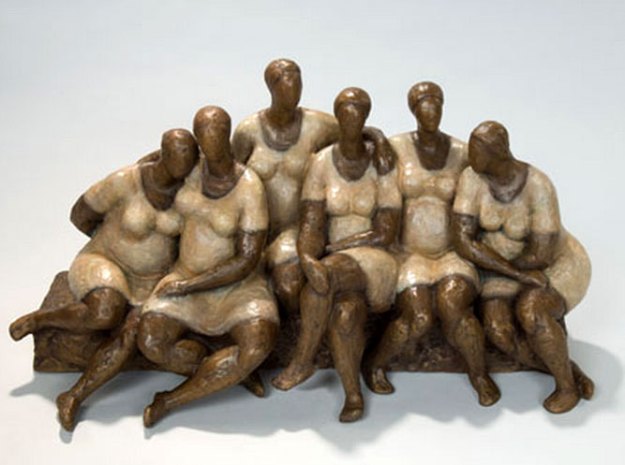
THREE WOMEN FRIENDS Sculpture by Nnamdi Okonkwo, Harlem, New York City

“Three Friends” is a sculpture by the Nigerian born Nnamdi Okonkwo that currently resides at the front of Fifth Avenue on the Park, a condominium building in Harlem.
Nigerian sculptor Nnamdi Okonkwo created this monumental sculpture that stands outside of Fifth Avenue on the Park, a condominium building in Harlem area of New York City.

The condominium overlooks Marcus Garvey Park and is located at 120th Street and Fifth Avenue. This bronze sculpture was installed in July of 2010 and truly beautifies the front of the building and the entire area.

The following words from the sculptor:

I believe that life is not ordinary, but that there is a heroic, monumental, and divine capacity to the human spirit. Sculpture is an avenue for me to express this beauty and nobility that is inherent in humanity. In short, I seek for the sublime in the emotions and feelings, which my figures evoke. I have chosen the female form to portray this magnificence of the soul, because in my indigenous culture, womanhood is venerated, and “mother is supreme.”

I believe that the noble virtues such as serenity, love, hope, humility, charity, and inner strength, which enable us to face and transcend the adversities of life, are best exemplified in womanhood. The voluminous shapes are aesthetically pleasing and intoxicating to me, but they also serve to emphasize the largeness of soul of womanhood.

Born in Eastern Nigeria in 1965, Nnamdi is the first of three sons. He currently reside in Fayetteville, Georgia with his  wife and three children. After obtaining a Degree in painting in Nigeria, basketball became the avenue for Nnamdi to come to the United States because of his height.

He was recruited by BYU-Hawaii where he played from 1989-1993, and graduated with a BFA in Sculpture. After which he enrolled in the graduate program at BYU-Provo and received an MFA degree in sculpture in 1997.  His work is represented in galleries across the country, and can be seen in individual and public sculpture gardens as well.

http://youtu.be/onhatuvyB-s

http://shellielewis.files.wordpress.com/2012/03/nnamdi-okonkwo-1.jpg

http://shellielewis.files.wordpress.com/2012/03/nnamdi-okonkwo-2.jpg


Catching Up With Former Third World Percussionist – Willie Stewart

http://youtu.be/tKRJlmqXPVY http://youtu.be/EcJ61-pee70 Have you ever wondered what became of the group Third World ? Well! I had the pleasure of catching up with former Third World Percussionist – Willie Stewart through a phone conversation. Willie is the founder of Solution in Music, he has shared his brilliant talent in rhythm and percussion with kids through his foundation. In my conversation with him, I realized that his excitement was not in past tales of his world travels, multiple Grammy nominations nor his celebrity status twenty-two years ago as the drummer for Third World band, but rather, his passion to bring music to people – especially children. “It’s not about me and what I can play, he said, “It’s about using the programme to make the people feel like they achieved something – to be inspired, to be motivated.”Children are our most treasure asset, we must love, protect and nurture them so that they may realize their dreams.

Although, he left the Third World band nearly 20 years ago, drummer Willie Stewart is still making rhythmic noise in South Florida. His commitment to continue to work hard and stay committed to empowering  our youth and communities. The power of music has definitely earned Willie recognitions in Jamaica, the U.S and in South Florida, where he currently reside.

Willie is among the recipients of the 2012 Jamaica Diaspora Honours which were recently announced by Jamaica’s Consul General, Sandra Grant-Griffiths. Through his non-profit organization, Embrace Music Foundation (EMF), Willie conducts percussion workshops in schools and communities.

EMF’s latest programme is Rhythms of Africa/Music Around the World, seven two-hour workshops that unite musical concepts such as rhythm and tone, with ethnic studies and language. The London-born Stewart started his career in the early 1970s as a member of the popular Inner Circle band, then toured with Byron Lee (his older brother) and the Dragonaires.

Willie joined Third World in the mid-1970s, playing on the band’s landmark albums such as 96 Degrees in the Shade and Journey to Addis, as well as the hit songs, Now That we Found Love and Try Jah Love.

I asked Willie ‘ do you see yourself coming to perform in Nigeria any time soon? It’s been in the radar, he replied, “I had a good time in Lagos, Nigeria and would like to give something back to the people of Africa.

This slideshow requires JavaScript.