Tag Archives: Nigeria

UNGUARDED – PREMIERES IN NEW YORK CITY NOVEMBER 3, 2012


Synopsis
Elvin (Ramsey Nouah), an apparent successor to Software Solutions, a multi-million dollar company, is dropped into the deep end after he finds out that his undeniably clever, manipulative fiancée, Natasha (Edosa Edosomawan), has been sleeping with his father. Out of his despair, he convinces himself that every woman is despicable and resolves to take his own pound of flesh against women from every continent.

With his warm, charming personality, Elvin craftily weaves his way through the hearts of these women and successfully stands each of them up at the altar. In other to get to his last victim, an African journalist, Jane (Uche Jombo), Elvin takes up a job as a cleaner in Cool’s magazine company, same company Jane works for. Somehow a genuine romantic entanglement ensues between them.

Caught in the heat of the moment, Elvin proposes to Jane. His proposal triggers sudden unexpected visits and calls that sow seeds of skepticism in Jane’s mind. Undeterred by the circumstances, Elvin insists on winning Jane over even if he has to undergo a personality transformation.

Directed by Desmond Elliot, and Bethels Agomuoh. Produced by Chisom Oz-Lee, featururing Ramsey Nouah, Uche Jombo, Desmond Elliot, Chisom Oz-Lee, Chet Anekwe, Ebbe Bassey, and Edosa Edosomwan. MOVIE OFFICIALLY PREMIERES IN NEW YORK CITY ON NOVEMBER 3, 2012 @
TRIBECA CINEMAS


King Jaja of Opobo – England’s Affair With Him And The End Of It


Born in Umuduruoha, Amaigbo in Igboland and sold as a slave to a Bonny trader at the age of twelve, he was named Jubo Jubogha by his first master. He was later sold to Chief Alali, the head of the Opubo Annie Pepple Royal House. Called Jaja by the British, this gifted and enterprising individual eventually became one of the most powerful men in the eastern Niger Delta.

In the nineteenth century—after the abolition of the slave trade in 1807—the trade in slaves was supplanted by the trade in palm oil, which was so vibrant that the region was named the Oil Rivers area.

The Houses in Bonny and other city-states controlled both the internal and external palm oil trade because the producers in the hinterland were forbidden to trade directly with the Europeans on the coast; the Europeans never left the coast for fear of malaria.

Astute in business and politics, Jaja became the head of the Anna Pepple House, extending its activities and influence by absorbing other houses, increasing operations in the hinterland and augmenting the number of European contacts. A power struggle ensued among rival factions in the houses at Bonny leading to the breakaway of the faction led by Jaja. He established a new settlement, which he named Opobo. He became King Jaja of Opobo and declared himself independent of Bonny.

Strategically located between Bonny and the production areas of the hinterland, King Jaja controlled trade and politics in the delta. In so doing, he curtailed trade at Bonny and fourteen of the eighteen Bonny houses moved to Opobo.

In a few years, he had become so wealthy that he was shipping palm oil directly to Liverpool. The British consul could not tolerate this situation. Jaja was offered a treaty of “protection”, in return for which the chiefs usually surrendered their sovereignty. After Jaja’s initial opposition, he was reassured, in vague terms, that neither his authority nor the sovereignty of Opobo would be threatened.

Jaja continued to regulate trade and levy duties on British traders, to the point where he ordered a cessation of trade on the river until one British firm agreed to pay duties. Jaja refused to comply with the consul’s order to terminate these activities, despite British threats to bombard Opobo. Unknown to Jaja, the Scramble for Africa had taken place and Opobo was part of the territories allocated to Great Britain. This was the era of gunboat diplomacy, where Great Britain used her naval power to negotiate conditions favorable to the British.

Lured into a meeting with the British consul aboard a warship, Jaja was arrested and sent to Accra, where he was summarily tried and found guilty of “treaty breaking” and “blocking the highways of trade”.

Jaja was forced into exile at St. Vincent, as a political prisoner, and placed on annual income of 800 pounds which was far below estimated at 50,000 pounds income per annum in Opobo, and where he enjoyed a lavish life style, in his three storey pre-fabricated house imported from Liverpool. He was to remain is St. Vincent, against his will, for three years, and for four additional month in Barbados, from where it was decided he should return home to Opobo from exile.

Meanwhile, Jaja’s health in exile began to deteriorate to the extent that his doctor in St. Vincent reported in 1899 that, the more Jaja was retained in St. Vincent the nearer he would approach his grave. Jaja report was threatening to commit suicide unless he was allowed to return.

It took another two years for Jaja to be evacuated from St. Vincent , from where in February, 1891, he was transferred to Barbados. He was to remain in Barbados for another three months before he was conveyed to Spanish colony of Teneriffe, instead of Sierra Lone, on May 11, 1891. The plan was for him to remain there until the arrival of the British consul, Macdonald who was to take him back to Opobo, but, due to an outbreak of epidemic in the island, Macdonald did not arrive in June as expected.

Consequently Jaja waited hopelessly and in abject misery, soon contracted dysentery from which he died on July 7, 1891, after nearly four years in exile. His body was buried at Teneriffe. But in October, 1892, his body was exhumed and taken to Opobo where on October 12, it was received by a fleet at 60 war canoes each carrying each of the old warriors of King Jaja.

Years after his exile in St. Vincent Jaja, is still remembered in anecdotes, today in the West Indies, as he stays there made the land favourable impact on the people of St. Vincent and Barbados. To them Jaja remained a legendary figure. He is remembered for upholding the diginity and self respect of the African even in the most difficult conditions in which he found himself while on exile in Caribbean.

Based on the illegal exile of King Jaja of Opobo in the Caribbean, the situation in the Delta today is not different. The same vicious struggle for the control of the oil resources in the Delta has continued in a post colonial and independent federal Nigeria. The British Buccaneers have been replaced by non-indigenous local predators, that in collusion with the big foreign-owned oil companies have seized control of vast oil resources in the Delta area in a manner that can not be said to serve the economic interest of the people of the Delta. Like Jaja, the people of the Delta want to control their own resources.

This is what is responsible for the rebellion of the people of Niger Delta and the continuing violence in the area. What the situation call for is some restitution with the people of the Delta through real fiscal federalism.

Legacy

King Jaja was exiled for many years in Barbados, the West Indies. Then due to immense civil unrest caused by the presence of King Jaja by the enslaved people of Barbados and after years of campaigning for his freedom. Jaja was moved to the island of San Vicente, Cape Verde, West Africa. To prevent the possibility of a slave revolt.

When Jaja eventually won his liberty after years of fighting against his wrongful abduction and consequent exile by the British. It was agreed by Parliament that he could be reunite to his Kingdom State of Opobo. Jaja now an old man and after years in exile in San Vicente, his health had deteriorated but this did not deter him from embarking on a British vessel bound for Opobo.

His health had failed and on his way back to his beloved Opobo Jaja died due to ill health. He was then shipped instead to Tenerife where he was buried. Due to the anger and fury felt by his people on the chain of events that had preceded, Opobians made the demand for the body of their King which was promptly exhumed and transported back to Opobo where Jaja was buried.

As a loved King his people never forgot about him nor gave up hope that one day he would return. When his body was returned they proceeded to honour him in a manor befitting a much loved & Powerful King (Amayanabo) with 2 years of mourning and with a ceremony immortalising Jaja as a deity.

Harlem’s Nnamdi Okonkwo Nigerian Sculpturist


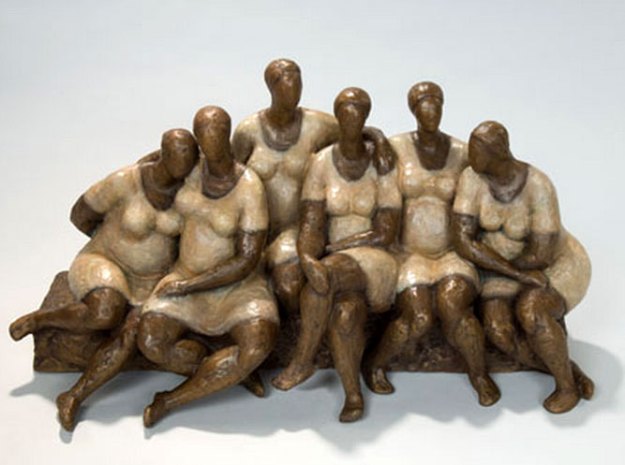
THREE WOMEN FRIENDS Sculpture by Nnamdi Okonkwo, Harlem, New York City

“Three Friends” is a sculpture by the Nigerian born Nnamdi Okonkwo that currently resides at the front of Fifth Avenue on the Park, a condominium building in Harlem.
Nigerian sculptor Nnamdi Okonkwo created this monumental sculpture that stands outside of Fifth Avenue on the Park, a condominium building in Harlem area of New York City.

The condominium overlooks Marcus Garvey Park and is located at 120th Street and Fifth Avenue. This bronze sculpture was installed in July of 2010 and truly beautifies the front of the building and the entire area.

The following words from the sculptor:

I believe that life is not ordinary, but that there is a heroic, monumental, and divine capacity to the human spirit. Sculpture is an avenue for me to express this beauty and nobility that is inherent in humanity. In short, I seek for the sublime in the emotions and feelings, which my figures evoke. I have chosen the female form to portray this magnificence of the soul, because in my indigenous culture, womanhood is venerated, and “mother is supreme.”

I believe that the noble virtues such as serenity, love, hope, humility, charity, and inner strength, which enable us to face and transcend the adversities of life, are best exemplified in womanhood. The voluminous shapes are aesthetically pleasing and intoxicating to me, but they also serve to emphasize the largeness of soul of womanhood.

Born in Eastern Nigeria in 1965, Nnamdi is the first of three sons. He currently reside in Fayetteville, Georgia with his  wife and three children. After obtaining a Degree in painting in Nigeria, basketball became the avenue for Nnamdi to come to the United States because of his height.

He was recruited by BYU-Hawaii where he played from 1989-1993, and graduated with a BFA in Sculpture. After which he enrolled in the graduate program at BYU-Provo and received an MFA degree in sculpture in 1997.  His work is represented in galleries across the country, and can be seen in individual and public sculpture gardens as well.

http://youtu.be/onhatuvyB-s

http://shellielewis.files.wordpress.com/2012/03/nnamdi-okonkwo-1.jpg

http://shellielewis.files.wordpress.com/2012/03/nnamdi-okonkwo-2.jpg


Catching Up With Former Third World Percussionist – Willie Stewart

http://youtu.be/tKRJlmqXPVY http://youtu.be/EcJ61-pee70 Have you ever wondered what became of the group Third World ? Well! I had the pleasure of catching up with former Third World Percussionist – Willie Stewart through a phone conversation. Willie is the founder of Solution in Music, he has shared his brilliant talent in rhythm and percussion with kids through his foundation. In my conversation with him, I realized that his excitement was not in past tales of his world travels, multiple Grammy nominations nor his celebrity status twenty-two years ago as the drummer for Third World band, but rather, his passion to bring music to people – especially children. “It’s not about me and what I can play, he said, “It’s about using the programme to make the people feel like they achieved something – to be inspired, to be motivated.”Children are our most treasure asset, we must love, protect and nurture them so that they may realize their dreams.

Although, he left the Third World band nearly 20 years ago, drummer Willie Stewart is still making rhythmic noise in South Florida. His commitment to continue to work hard and stay committed to empowering  our youth and communities. The power of music has definitely earned Willie recognitions in Jamaica, the U.S and in South Florida, where he currently reside.

Willie is among the recipients of the 2012 Jamaica Diaspora Honours which were recently announced by Jamaica’s Consul General, Sandra Grant-Griffiths. Through his non-profit organization, Embrace Music Foundation (EMF), Willie conducts percussion workshops in schools and communities.

EMF’s latest programme is Rhythms of Africa/Music Around the World, seven two-hour workshops that unite musical concepts such as rhythm and tone, with ethnic studies and language. The London-born Stewart started his career in the early 1970s as a member of the popular Inner Circle band, then toured with Byron Lee (his older brother) and the Dragonaires.

Willie joined Third World in the mid-1970s, playing on the band’s landmark albums such as 96 Degrees in the Shade and Journey to Addis, as well as the hit songs, Now That we Found Love and Try Jah Love.

I asked Willie ‘ do you see yourself coming to perform in Nigeria any time soon? It’s been in the radar, he replied, “I had a good time in Lagos, Nigeria and would like to give something back to the people of Africa.

This slideshow requires JavaScript.

Nigerian Political Independence and Pro-democracy Icon- Chief Anthony Enahoro

TODAY, I REMEMBER ONE OF THE TITIANS OF NIGERIA’S STRUGGLE FOR POLITICAL INDEPENDENCE AND PRO-DEMOCRACY ICON, MY UNCLE, CHIEF ANTHONY ENAHORO.  AS WE PREPARE TO CELEBRATE NIGERIA’S 52 INDEPENDENCE DAY ON OCT 1, 2012, LET’S NOT FORGET THE MEANING OF SACRIFICE, FREEDOM, UNITY AND PATRIOTISM. ……….ASK NOT WHAT YOUR COUNTRY CAN DO FOR YOU BUT WHAT YOU CAN DO FOR YOUR COUNTRY. R.I.P PA.

Chief Anthony Enahoro (22 July 1923 – 15 December 2010) was Nigeria’s foremost anti-colonial and pro-democracy activists. He was born the eldest of twelve children in Uromi in the present Edo State of Nigeria. His Esan parents were Anastasius Okotako Enahoro (d. 1968) and Fidelia Inibokun née Ogbidi Okojie (d. 1969). Chief Enahoro has had a long and distinguished career in the press, politics, the civil service and the pro-democracy movement. Educated at the Government School Uromi, Government School Owo and King’s College, Lagos, Chief Enahoro became the editor of Dr. Nnamdi Azikiwe’s newspaper, the Southern Nigerian Defender, Ibadan, in 1944 at the age of 21, thus becoming Nigeria’s youngest editor ever. He later became the editor of Zik’s Comet, Kano, 1945–49, also associate editor West African Pilot, Lagos, editor-in-chief Morning Star from 1950 to 1953.

And In 1953, Chief Anthony Enahoro became the first to move the motion for Nigeria’s independence and consequences,he has been regarded by academics and many Nigerians as the father of “Nigeria State” Though his motion was rejected by Parliament and the northern MP’s staged a walkout as a consequence of the attempt. The actual successful movement of the motion for Nigeria’s independence did not take place until 1958. After Enahoro’s initial attempt in 1953, Chief S.L. Akintola attempted to move the second motion for Nigeria’s independence in 1957 and though his motion was passed by Parliament it was not acquiesced to by the British colonial authorities and it therefore failed.

The successful moving of the motion for Nigeria’s independence did not take place until August 1958 and this was done by Chief Remi Fani-Kayode. Fani-Kayode’s motion was not only passed by Parliament but it was also acquiesced to by the British. His motion had called for independence to be granted to Nigeria on April 2, 1960 and though it was passed by Parliament and acquiesed to by the British a slight amendment proposing that the month of independence should be moved from April 2 to October 1 was proposed by a fourth motion to Parliament by Sir Tafawa Balewa in 1959 and it was passed.As a consequence of that Nigeria gained her independence in 1960.

He was born the eldest of ten children in Onewa village, Uromi, in the present Edo State of Nigeria. His Esan parents were Anastasius Asuelinmen “Okotako” Enahoro (d. 1968) and Fidelia Inibokun née Ogbidi Okojie (d. 1969). Chief Enahoro has had a long and distinguished career in the press, politics, the civil service and the pro-democracy movement. Educated at the Government School Uromi, Government School Owo and King’s College, Lagos, Chief Enahoro became the editor of Dr. Nnamdi Azikiwe’s newspaper, the Southern Nigerian Defender, Ibadan, in 1944 at the age of 21. AS a student then at the famous Kings College, Chief Enahoro plunged into the Nigerian turbulent liberation struggle against colonial rule in the early 1940s, leading to student revolts at the college, in Lagos where he was a student leader. He was prominent in politics at a time of rapid change. He was twice jailed for sedition by the colonial government, for an article mocking a former governor, and then for a speech allegedly inciting Nigerian troops serving in the British army. The British marked him as a firebrand, but even as he was jailed for a third time, he was beginning to reassess his position.

During the Nigerian crisis that followed the 1966 coups, Chief Enahoro was the leader of the then Mid-West delegation to the Ad HocConstitutional Conference in Lagos. He later became Federal commissioner (Minister) for Information and Labour under the General Yakubu Gowon Military Government, 1967–74; Federal Commissioner for Special Duties, 1975. He later became member of the National Party of Nigeria, NPN, 1978–83. He was the president, World Festival of Negro Arts and Culture, 1972–75.

Chief Enahoro was the chairman of the National Democratic Coalition (NADECO), a pro-democracy group that fought dictator Sani Abacha till Abacha’s death. Chief Enahoro was conferred with the national honour of Commander, Order of the Federal Republic, CFR, in 1982, and is the chairman of the Movement for National Reformation, MNR; as well as the Pro-National Conference Organisation, PRONACO. He was awarded honorary DSC by the University of Benin in 1972. Among his publications include the treatise Fugitive Offender. Chief Enahoro played golf and followed cricket ardently. [1][2][3] Chief Enahoro was a delegate to most of the constitutional conferences leading to the independence of Nigeria in 1960.

During the 1962 crisis in the old Western region, he was detained along with other Action Group members. Accused of treason during the Awolowo alleged coup trial, Chief Enahoro escaped via Ghana to the United Kingdom in 1963, Nigeria requested Enahoro’s extradition under the 1881 Fugitive Offenders Act, preventing his application for political asylum. Early in 1963, the new leader of the Labour party, Harold Wilson, detected the embarrassment caused by Enahoro’s arrest and imprisonment. Labour went on the attack in the Commons, with support from some Tories, backed by a media furore. He was once one of the best-known Nigerians in Britain. He was the “fugitive offender” who triggered days of debate in the House of Commons in 1963 as he battled against extradition.

“The Enahoro affair” became an issue of human rights versus the government’s pusillanimous wish not to offend Nigeria, and put the Tory prime minister, Harold Macmillan, and his home secretary, Henry Brooke, in a difficult position.

He was extradited from the UK and imprisoned for treason. In 1966, he was released by the Military Government.

Legacy

In 1953, Chief Anthony Enahoro initiated the self-government motion in the Western House of Assembly, which eventually led to Nigerian Independence on the 1st day of October, 1960.

Sport

Chief Enahoro came from a sporting background. He excelled in sports at King’s College and is credited with being the first Nigerian National to gain membership of a golf club in Nigeria. He managaged to bring his handicap down into single figures during his long golfing career. He was also the driving force behind bringing FESTAC to Nigeria in the 1970s, during which time both Muhammed Ali and Pele visited the country to widespread acclaim.

All his children excelled at sport during their schooling and University years, playing Football, Rugby, Golf and Tennis. Currently, Kenneth and Eugene are avid golfers and founding members of the Saturday Society at Benin Golf Club. Annabella practices Pilates and Gabriel is an avid cyclist.

Chief Enahoro is survived by his wife Helen (née Ediae),their five children; Kenneth Enahoro, Eugene Enahoro, Victor Enahoro, Annabella Enahoro and Gabriel Enahoro and several grandchildren.